
Your CRM set up by people who sold.
Sander Vergouwen and Bart-Jan Hin spent years in B2B sales themselves before they started Sales Surge in 2023.
150+
CRM implementations delivered, where the patterns on this page come from
Sales-Surge B.V., November 2026
90%+
user adoption, because we design the pipeline with the reps who use it
Sales Surge implementations
6 hours
per person per week back, by automating the clicks a rep would otherwise make
What to expect from us.
We come from sales
Sander spent more than 10 years in B2B sales and built the sales team at Rodeo Software from scratch. Bart-Jan managed sales teams in several sectors.
You talk to a co-founder first
Your intro call is with Sander or Bart-Jan. After that our implementation team does the build, in phases, with a handover at the end of each one.
You see the price up front
A CRM implementation starts at 2,950 euros and the Audit costs 2,200 euros. The pricing page shows what each service includes.
What we do not take on: a project without a CRM in it, or the cheapest setup with no talk about your process. Other agencies do that better, and we will tell you so.
Why choose a CRM partner that has sold?
Because someone who has carried a sales target builds a CRM that reps work in, not just a CRM that looks good in a board meeting. Here is where the difference comes from.
Most CRM partners are not bad at their job. They are good at the job they actually do. The problem is that the job they do is rarely the job a B2B sales team actually needs done.
When a CRM is set up by someone from a marketing background, it gets optimised for lead capture, email sequences, and campaign attribution. The funnel looks beautiful from the top. Forms feed the database, automations send the right nurture, dashboards count the leads. But somewhere between MQL and closed deal, the system gets thin. The handover to sales is a status change, not a workflow. The follow-up logic is built around send cadences, not around buyer signals. The reports answer questions a CMO loves and a sales manager cannot use to forecast.
When a CRM is set up by a tech consultant, it gets optimised for clean data structures and integration architecture. Every field has a logic. Every webhook fires on the right event. The schema is a thing of beauty. But the reps have to fill in seven fields to log a meeting, and three of them are mandatory dropdowns nobody updated since launch. The system is technically perfect and operationally dead.
Both backgrounds produce useful work. Neither, on its own, produces a CRM that closes more deals. What gets missed without sales experience is specific and repeatable: pipeline stages designed around internal process steps instead of buyer decisions; no real distinction between a lead that is interested and a lead that is actually buying; follow-up logic built for volume instead of timing and context; reports that track activity metrics instead of revenue predictors; and, eventually, a CRM that sales managers love in board meetings and reps quietly ignore in their day.
When the person building your CRM has carried a number, they think differently. They know which fields a rep will actually fill in, because they have skipped the same fields themselves on a Friday afternoon. They know which automation removes work and which automation is a new admin step in disguise. They know the difference between a pipeline that looks healthy and one that actually closes, because they have been the person trying to make a fake-healthy pipeline produce a real number at the end of the quarter.

Sander Vergouwen
Co-founder
Sander Vergouwen, co-founder: 10+ years in B2B sales before founding Sales Surge. Head of Sales at Rodeo Software, where he built the sales team from scratch and drove 340% revenue growth. Not by installing software. By selling.

Bart-Jan Hin
Co-founder
Bart-Jan Hin, co-founder: 20+ years in sales, CRM, and RevOps across multiple sectors. Has managed sales teams, built pipelines, and seen what breaks at scale.
- Sander was also a Senior CRM Consultant at Leapforce, a HubSpot Diamond Partner. So he knows the CRM from both sides of the table: as the seller who has to work in it and as the consultant who builds it.
- Sales Surge is a Pipedrive Platinum Partner and won the Pipedrive 2026 Top New ARR Partner Award.
- We have delivered more than 150 CRM implementations. The three patterns further down this page come from that work.
What you can hold us to.
- Always Hungry
- After go-live we check who uses the system, and we adjust on that.
- No Ego
- You hear which system fits you, even when that is not our own Lumo.
- OWN IT
- Every phase has a fixed price, and you sign off before we build.
What does Sales Surge mean?
A sales surge is a sudden, sharp rise in sales. We chose the name because that is what a CRM that the team actually uses should produce.
Sales Surge is also the trading name of Sales-Surge B.V., a Dutch company founded in 2023 that helps B2B teams get more grip on their commercial growth, across marketing, sales, projects, customer success and ticketing.
The tagline is Align · Automate · Accelerate. Align means getting strategy and process on one line. Automate means taking repetitive work out of the day with workflows and AI. Accelerate means growing on numbers you can trust instead of gut feeling.
What "full-funnel" actually means when sellers build your CRM
Full-funnel is one of the most overused phrases in our industry. It usually means a slide with arrows. When a sales-led team uses the phrase, it means something concrete: every step from first touch to signed deal is reflected in the CRM, every transition triggers an action, and no deal goes cold without a human knowing it.
Top of funnel
Lead capture from outbound (Apollo.io and Instantly.ai), inbound forms, and LinkedIn (Dux-Soup) feeds directly into Pipedrive with the right source, sector, and ICP data attached. No manual entry. No reps copying email addresses out of an inbox.
Middle of funnel
Every stage transition triggers an action. Inactivity triggers a follow-up. No deal goes cold without a rep being notified, and no rep gets reminded for a deal that does not deserve another touch.
Bottom of funnel
Proposals are sent via PandaDoc with automatic status tracking back into Pipedrive. Won deals trigger onboarding tasks for delivery. Lost deals trigger a loss-reason capture and an automated re-engagement sequence ninety days later, because the deals that lose this quarter often close the next one.
Reporting
Dashboards show conversion by stage, deal velocity, and pipeline coverage ratio. The metrics a sales manager actually uses to run a forecast, not just activity counts that look busy on a Monday.
Why most CRM implementations fail, and why ours do not
With a new client, we often open their Pipedrive account together for the first time. The pattern is almost always the same. Three failure modes, in this order.
Failure 1: The stages are wrong
Not wrong as in badly named. Wrong as in they describe what the seller does, not what the buyer decides. A stage called "Proposal Sent" is an activity. A stage called "Proposal Under Internal Review" is a buyer state. One of these tells you what happened. The other tells you where the deal actually is. If your pipeline is a list of things your team does, you cannot forecast from it. You can only count it.
When we redesign stages, we start with the buyer. What decision are they making at this point. What do they need to be true to move to the next decision. Where, in your real history, do deals stall. The stages that come out of that conversation are usually shorter than the ones we replace, and always more honest.
Failure 2: The automations are theatre
An automation that sends a congratulations email when a deal is won is not a revenue driver. It is a feel-good notification. Real automation removes the manual steps that cause deals to go cold: the follow-up that did not happen because the rep had forty open deals, the re-engagement that was planned but never scheduled, the handover from sales to onboarding that happens three days late because nobody remembered to send the email.
The test we apply is simple. If the automation removes a click a salesperson would otherwise have to make, it earns its place. If it adds a new required field, sends an internal notification nobody reads, or exists mainly so the agency can demo it, it gets cut. At Ontslagrecht Juristen that saved 6 hours per person per week.
Failure 3: The reps never bought in
Adoption is not a training problem. It is a design problem. Most failed implementations were designed for the CRM manager and the marketing team. The reps got a two-hour training session and a 40-page PDF. Within sixty days, half the deals lived in the CRM and half lived in someone's notebook or inbox.
What Sales Surge does differently: discovery starts with the salespeople, not the managers. Pipeline stages are validated with the reps who will use them every day. Automation removes their manual work, it does not add new required fields. Training is done in their live environment on their actual deals. And post-launch support is included, because that is when the real questions appear, not in week one, but in week six when the first weird deal hits a stage transition the playbook did not anticipate.
The result shows in usage. Our implementations reach user adoption above 90%.
What clients noticed.
What clients noticed.
- Client: Evans WatsonWhat it delivered: 20%+ more margin through automationThe sales process runs in the background, so the team can spend its time on calls.
- Client: BOOH MediaWhat it delivered: Live in Pipedrive in 5 days4 weeks were planned. A seven-stage pipeline with digital signing went live in 5 days.
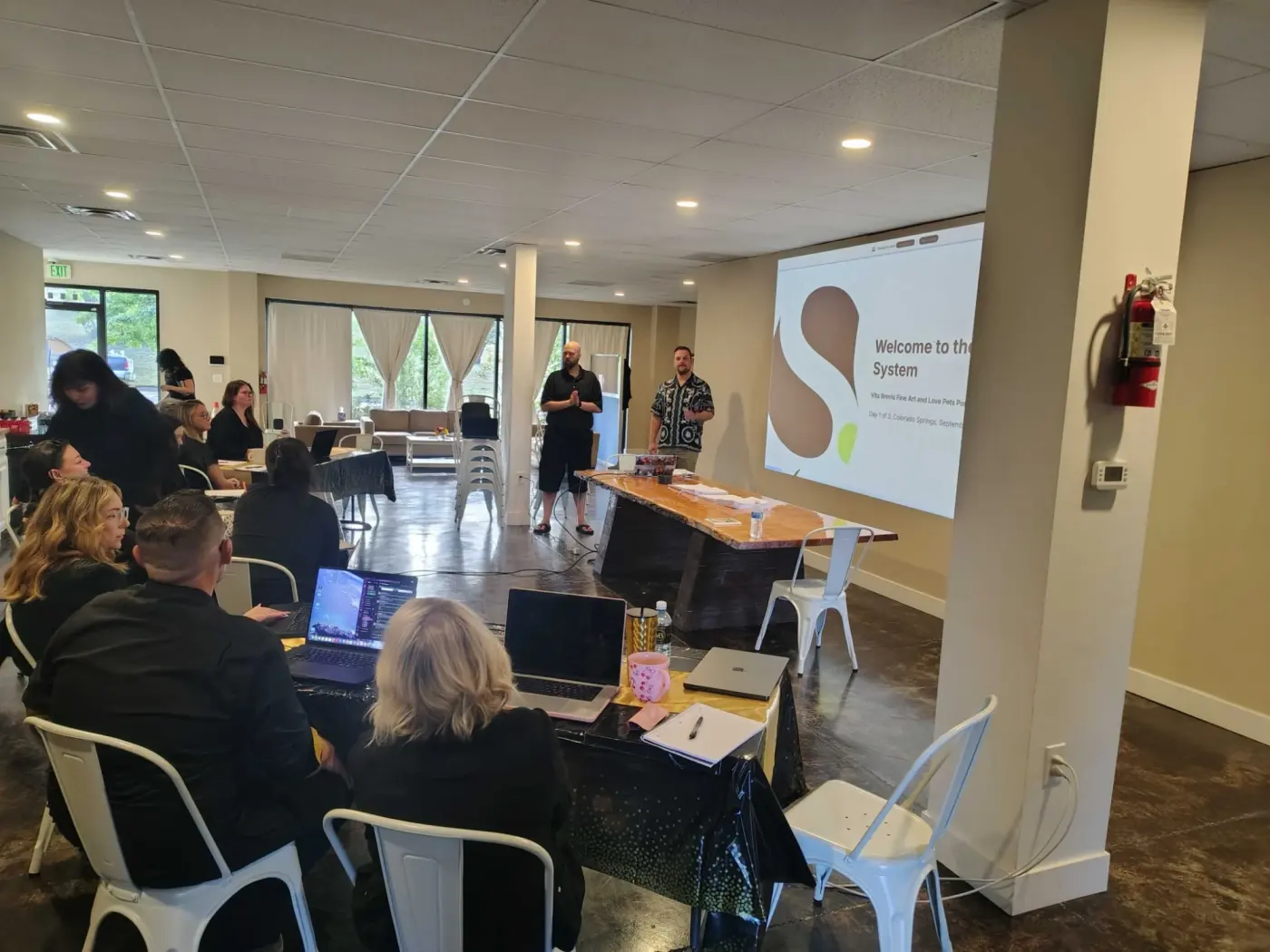
- Client: Vita Brevis Fine ArtColorado SpringsWhat it delivered: Live in 22 weeksOwn apps inside Pipedrive and JustCall campaign dialing, with training on location.
Is Sales Surge the right partner for you?
If you plan to outsource your CRM implementation, check the fit before you look at the price. Not every B2B company is the right client for us, and pretending otherwise wastes everyone's time. Here is the honest version, in both directions.
Sales Surge works best for
- B2B companies with a defined sales process that needs to be systemised, not invented from scratch.
- Teams where reps spend a large part of their week on admin, and the founder knows that is too much.
- Companies that have bought Pipedrive but never fully implemented it, and now want it to actually run the sales team.
- Scale-ups that need a CRM that grows with them for the next three to five years, not one that needs rebuilding in eighteen months.
- Founders and sales leaders who want to see the pipeline in real time, not manage it in spreadsheets and slides.
Sales Surge is probably not the right fit for
- Companies that want the cheapest possible setup with no strategic input. There are good agencies for that work. We are not one of them.
- Teams that are not willing to change how they currently work. A new CRM cannot fix a sales process the team refuses to revisit.
- Businesses that need enterprise-level complexity (1,000+ seat deployments, multi-region governance models, deeply customised Salesforce environments). We mostly work with teams of 10 to 500 people, and above that another partner will serve you better.
Frequently asked questions
In short
Sales Surge is a CRM partner from Amstelveen, founded in 2023 by two people from sales. Sander Vergouwen was Head of Sales at Rodeo Software. Bart-Jan Hin has worked in sales, CRM and RevOps for more than 20 years. We are a Pipedrive Platinum Partner, in the top 8 worldwide since July 2026, with more than 150 CRM implementations delivered. We also implement HubSpot, Zoho and Lumo.
Source: Sales-Surge B.V. and Pipedrive, November 2026.
Does Sales Surge only work with companies in the Netherlands?
No. We are based in Amstelveen and most of our clients are in the Netherlands or Belgium, but we also run implementations elsewhere in Europe in English. US teams work with us under our US brand PipeDriven. The work is the same everywhere. Only the language of delivery follows the team, Dutch or English.
What is the typical profile of a Sales Surge client?
A B2B company with a team of 10 to 500 people, a sales process that already exists, and a founder or sales leader who wants the CRM to run the sales team rather than document it after the fact. We see a lot of SaaS, professional services, recruitment and B2B services. Below ten people, a full CRM implementation is often too heavy, and the free growth scan is a better first step.
How involved are the founders in an implementation?
Your intro call is with Sander or Bart-Jan themselves, and the shape of your pipeline is set in that conversation and the blueprint that follows. The day-to-day build is done by our implementation team. You get a fixed contact person and a handover at the end of every phase, so you always know who is working on what.
What makes Sales Surge different from a marketing agency that also offers CRM?
A marketing agency optimises the CRM for lead generation and attribution, because that is the work they understand. We optimise it for the part of the funnel where revenue actually happens: pipeline stages, follow-up, deal velocity, and forecasting. Both can be useful. They are not the same product.
Can Sales Surge help us if we already have Pipedrive but it is not being used?
Yes. A large part of our work is existing Pipedrive accounts that were never set up properly. We start with a free growth scan: we look at the current setup and tell you what is salvageable. For more depth there is the Audit of 2,200 euros. Sometimes it is a focused repair, sometimes a rebuild is faster. We would rather say that in week one than in month three.
Do you work with CRMs other than Pipedrive?
Yes. Pipedrive is where we are strongest, as a Platinum Partner, but we also implement HubSpot, Zoho and Lumo, and we migrate between all four. If Pipedrive does not fit your situation, we tell you before you sign. We do not set up Salesforce from scratch.
Certified partner
Pipedrive Platinum Partner, top 8 worldwide
Also a certified partner of HubSpot, Zoho and Make.com.








Certifications
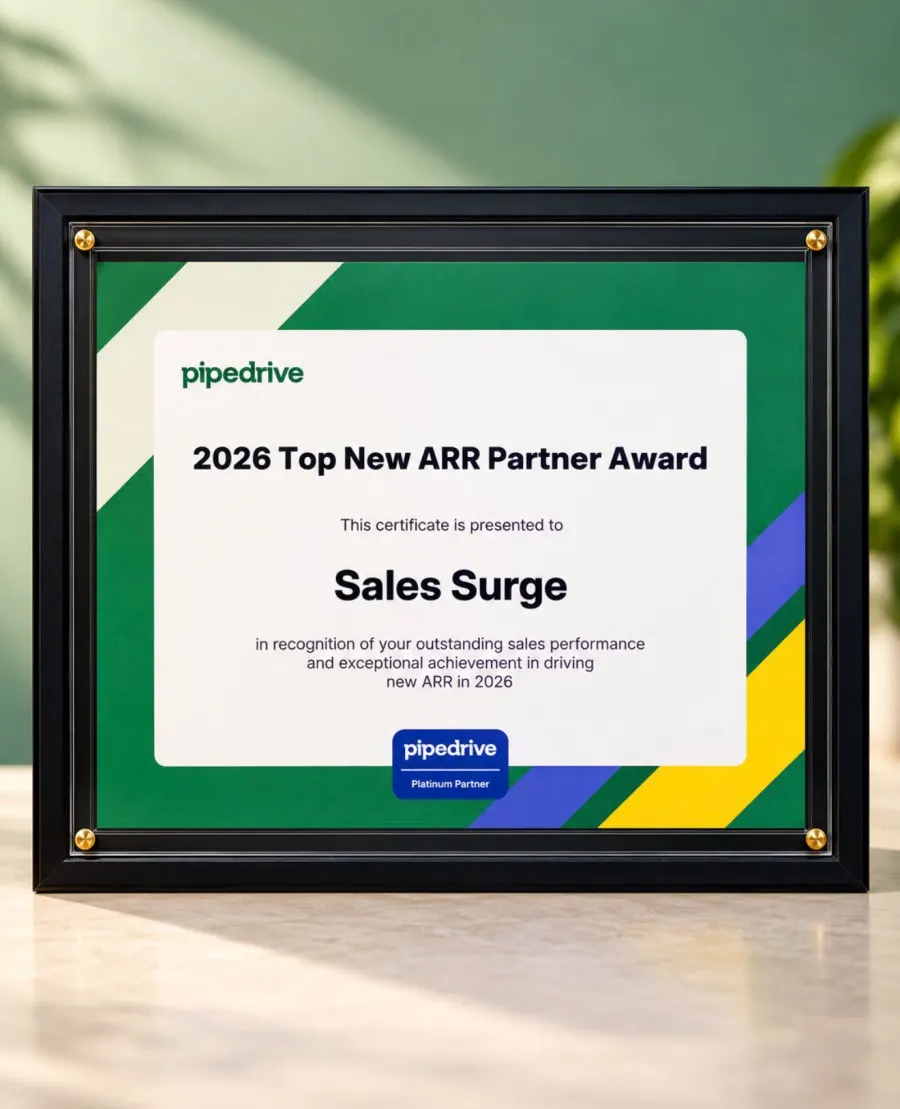
Top New ARR Partner Award 2026
Presented by Pipedrive at its annual partner event
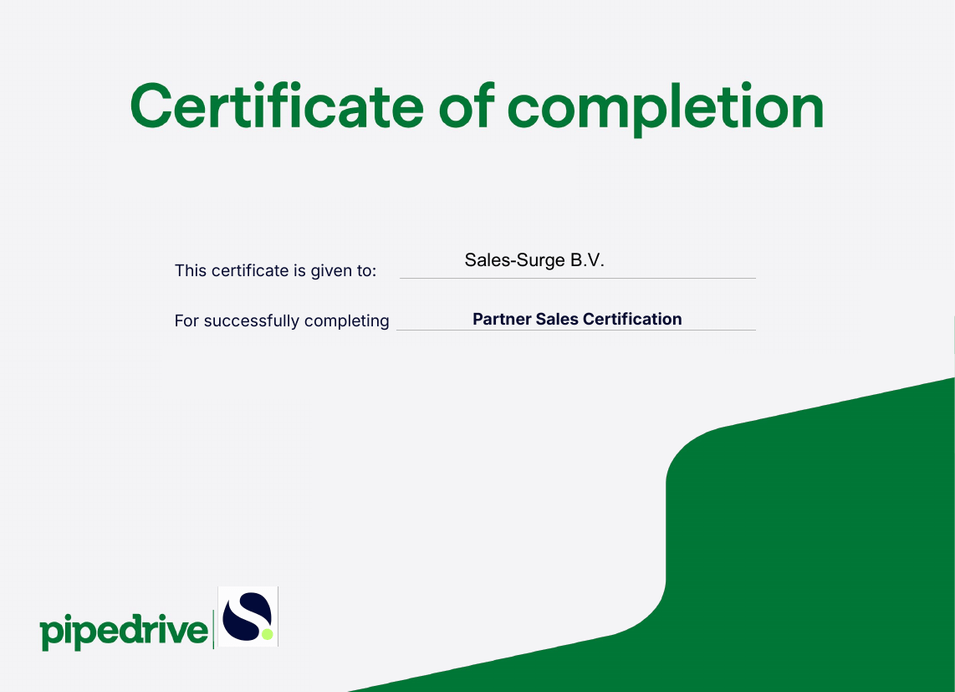
Pipedrive certified
Get started
See where your growth opportunities are.
We set up your CRM and connect it to everything else. What does not exist yet, we build.