In short
Source: Sales Surge, AI Sprint pricing and methodAs of: 16 November 2026
In this article
- What is a B2B AI sales agent?
- AI sales agents, AI sales agent software, or an AI sales agent platform?
- What can an AI sales agent actually do for a B2B company?
- What an AI agent cannot do (yet)
- Buy an AI sales agent or have one built?
- Is an AI sales agent allowed? AI Act, GDPR and call recording
- How Sales Surge builds AI agents
- How long does it take to build and launch?
- What does an AI sales agent cost?
- AI sales agent running costs: what you pay per month
- What we measure on an agent
- Where to start with AI in sales
- Frequently asked questions
What is a B2B AI sales agent?
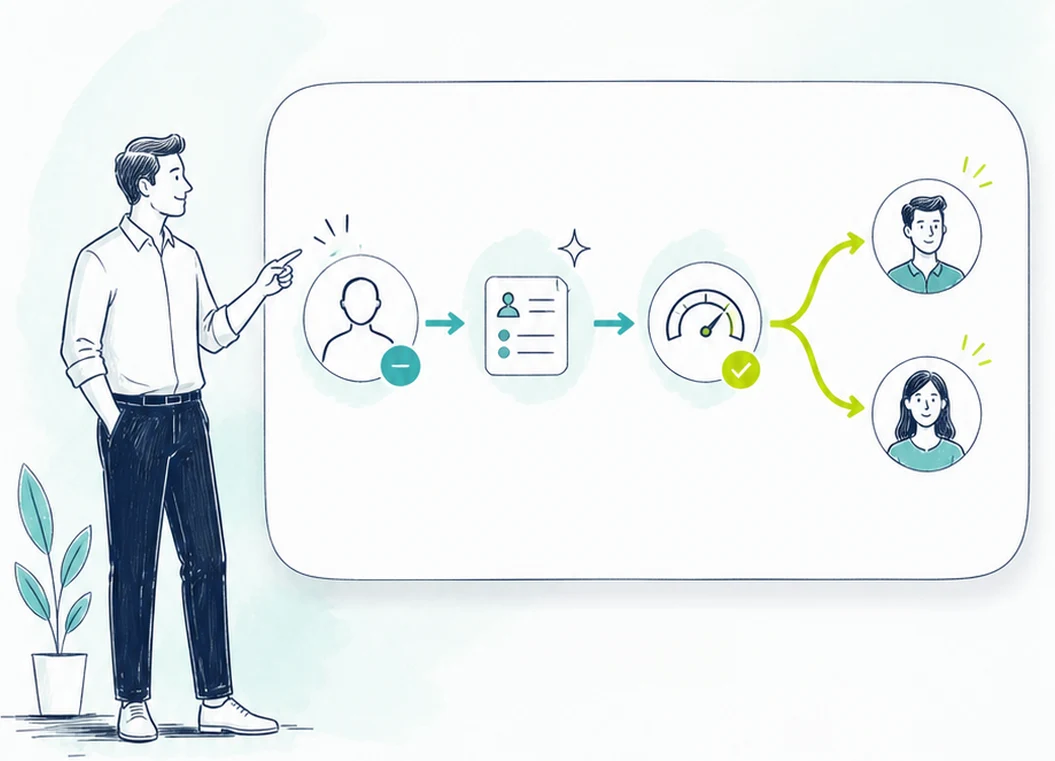
A B2B AI sales agent is software that does one specific job in the sales process on its own. It qualifies inbound leads, follows up on no-shows, or chases deals that went quiet. The agents that work in production do one job. The ones that fail are sold as a complete AI salesperson.
Underneath there are two layers. The language model reads the prospect's message, decides what to say and writes a reply. The workflow layer connects that model to your CRM, calendar, telephony and data sources. Without the workflow layer the model is a clever chat that goes nowhere. Without the model the workflow is the rules-based automation companies have run for years.
Berend de Visser, our virtual assistant, is an AI agent and not a person. We recommend that every client is just as open about their own agent. A buyer who finds out later that they were talking to software trusts you less, and since 2 August 2026 the AI Act requires you to tell them.
AI sales agents, AI sales agent software, or an AI sales agent platform?
AI sales agent software is a product you license, with a builder and connectors. An AI sales agent platform goes one step wider: a place to run many agents, with monitoring around them. Both are containers. An agent is the thing inside that does the work: one job, permission to act in your CRM, and a defined point where it hands over to a person.
That is why the market for AI agents for sales looks confusing. Most of what is advertised sits at the software or platform layer, so a demo shows a builder rather than a working agent. For a first agent, a platform is usually more than you need.
What can an AI sales agent actually do for a B2B company?
An AI sales agent handles work that is high in volume, repeats and has clear rules. These are the jobs we scope agents for.
- Qualify inbound leads by chat or phone, around the clock. The agent asks the questions your team would ask. Anything inside the ICP goes to a booking flow.
- Follow up on no-shows and stalled deals. The agent watches Pipedrive for missed meetings and deals without activity, sends a message that knows the context, and books a new slot or moves the deal to nurture.
- Book meetings in the rep's real calendar. Once a lead qualifies, the agent offers real slots and logs the meeting in the CRM with the conversation attached.
- Update the CRM after every conversation. Stage, next step and qualification go back into structured fields, not into a note nobody reads.
- Hand hot leads to a person in seconds. When a lead names a budget, a deadline or a competitor, the agent alerts the rep in Slack or by phone.
What an AI agent cannot do (yet)
One version of the pitch says you can replace your whole SDR and AE team. That version is wrong. This is what agents do not do well, and why a person still owns the high-stakes parts of a deal.
- Negotiate with several stakeholders. Once procurement, legal and a buying committee join, an agent cannot read the room.
- Build the relationship on a large deal. Large B2B deals close on trust, and trust takes months of judgement calls in tense moments.
- Calm an upset customer. The answer has to come from someone who can fix the problem. An agent makes that moment worse by sounding rehearsed.
- Commit to anything the company must answer for. Prices, dates and deliverables stay outside what the agent may promise. That is why it works inside tight guardrails.
Agents win on volume and speed. They take the top of the funnel and the long tail of follow-up, so senior reps keep their time for the conversations that need judgement.
Buy an AI sales agent or have one built?
Buy a ready-made AI SDR when your process fits the tool and you sell mainly in English. Have one built on your own stack when the agent has to write to your CRM in your fields, speak Dutch, or follow a process that is specific to you. Several vendors sell an AI SDR as a product. This is how they compare with a sprint on your own stack, as of November 2026. Their products change quickly, so ask each vendor for a demo on your own data.
| Option | What it is | Channel | Inbound or outbound | Where the agent runs |
|---|---|---|---|---|
| 11x | AI SDR products for outbound prospecting | Email and phone | Outbound | In the vendor's platform, with a sync to your CRM |
| Artisan | An AI BDR for outbound prospecting | Outbound | In the vendor's platform, with a sync to your CRM | |
| Qualified | AI SDR for conversations with website visitors | Website chat | Inbound | In the vendor's platform, strongest alongside Salesforce |
| Regie.ai | AI agents and content for outbound sequences | Email sequences | Outbound | Next to your CRM and sales engagement tool |
| AI Sprint on your own stack | One agent built on your CRM, telephony and Make.com | Chat, phone or email, one per agent | Either, one job per agent | In your own tools, writing to your own Pipedrive fields |
The question behind 'buy an AI sales agent for pipeline growth' is usually speed. A product can be live quickly if your process matches its defaults. A build takes 10 working days but follows your process, your fields and your tone.
In any demo, ask to see a real CRM record before and after the agent acted, and a case where the agent decided not to act. A demo that only shows a builder is not an agent yet. If you sell in Dutch, ask for that demo in Dutch, and ask for a quote on your own volume rather than a list price. The AI Sprint is from €4,997 fixed, plus your own licences.
Is an AI sales agent allowed? AI Act, GDPR and call recording
Yes, as long as people know they are dealing with AI, you have a legal basis for the data, and calls are recorded only with notice. This is general information and not legal advice. For your own situation, have a lawyer check the set-up.
- Tell people they are talking to AI. Article 50 of the EU AI Act requires that people are informed when they interact with an AI system, unless that is obvious. These transparency rules apply since 2 August 2026. The EU has proposed shifting some AI Act deadlines, so check the current status. We build the notice into the first message or the start of the call.
- Have a legal basis for the lead data. Under the GDPR you need a basis to process a lead's data. In B2B that is often legitimate interest, which needs a written assessment. Enrichment from external sources counts as processing too.
- Record calls only with notice. Tell the caller at the start that the call is recorded and why, and offer a way to continue without recording. Keep recordings no longer than you need them.
- Sign a data processing agreement with every vendor. The voice platform, the telephony provider, the language model and the automation layer each process personal data. Each needs a data processing agreement.
- Prefer EU hosting. Where a tool offers EU data storage, use it. Where data leaves the EU, check that the vendor has valid transfer safeguards in place.
Outbound calling has its own rules too. In the Netherlands, calling consumers requires prior consent. B2B calls are allowed under conditions. An agent that calls out should follow the same rules as a person.
How Sales Surge builds AI agents
We build agents in a fixed programme of 10 working days called the AI Sprint. Fixed price from €4,997, fixed scope, one agent live in production at the end of the second week, with 30 days of support afterwards. We keep it short by limiting the scope to one agent and bringing a stack that is already connected.
| Layer | Tool | Role |
|---|---|---|
| Voice | ElevenLabs | The voice and the conversation layer of a voice agent, with low enough latency for a normal back-and-forth |
| Telephony | CloudTalk | Numbers, recording and a direct Pipedrive integration, so calls log against the deal |
| Workflow | Make.com | Moves data between model, CRM, calendar and Slack, and handles the escalation paths |
| CRM | Pipedrive | The agent reads deal context here and writes the outcome back as field changes |
More on the telephony side on the CloudTalk page.
How long does it take to build and launch?
One agent takes 10 working days from kick-off to live in production.
Days 1 to 3
Design
Days 4 to 6
Build
Days 7 to 9
Test and train
Day 10
Go-live
Agents with more than one job take longer and are better split into several agents, each with its own sprint.
What does an AI sales agent cost?
The sprint has a fixed price because its scope is fixed: one job, one channel and the standard stack. Voice, several languages, integrations outside the standard stack and high volume push the price up. A single-language chat agent with one integration keeps it down.
AI Sprint
from €4,997
Custom agent
quoted after scoping
Retainer
Priced in the quote
Prices exclude VAT. Licences for your tools and the running costs below come on top. Is a quote much cheaper, ask to see the agent change a field in your CRM. If it can only answer questions, you are buying a chatbot. More on the AI sales agents service page.
AI sales agent running costs: what you pay per month
AI sales agent running costs are the sum of four meters, and each one grows with volume: voice minutes, language model usage, telephony and Make.com operations. The build price above is fixed. The running cost depends on how many conversations the agent has and how long they are. Vendor prices change often, so below is the volume calculation without prices. Fill in your own tariffs.
A worked example. You receive 300 inbound leads a month. The agent handles 60% of them, so 180 conversations. A voice conversation takes 4 minutes on average, with about 10 turns in which the model reads and replies. Each conversation takes 8 Make.com operations: read the deal, look up the person, write three fields, check the calendar, book the slot and post to Slack.
| Meter | Formula | In the example | Your tariff |
|---|---|---|---|
| Voice | Conversations × average minutes | 180 × 4 = 720 minutes | Price per voice minute × 720. Chat-only agents skip this meter |
| Language model | Conversations × turns | 180 × 10 = 1,800 model calls | Price per call, which depends on how much text and CRM context the agent reads per turn |
| Telephony | Numbers + call minutes | 1 number + 720 minutes | Number subscription + price per minute × 720 |
| Make.com | Conversations × operations per conversation | 180 × 8 = 1,440 operations | Fits in the plan you already have, or the step to the next plan |
Set the total next to the hours the agent takes over. In the example that is 180 conversations of 4 minutes, so 12 hours of calls, plus the logging and follow-up a rep would do after each one. If the four meters together cost more than those hours, the job is not a good fit for an agent yet, or chat is the better channel. Voice is usually the meter that grows fastest, so run this sum before you choose voice over chat.
What we measure on an agent
We judge an agent on what happens in the CRM, not on how natural it sounds. These are the numbers we set up for every agent we build, from the first week. Agree the threshold for each one before go-live, so a bad week leads to a change instead of a discussion.
- Conversations per week, per channel. Rule: compare with the number of leads that came in. If the agent talks to clearly fewer leads than arrive, the trigger misses some of them.
- Share that ends as qualified, and share that ends with a hand-over. Rule: set both against what your team reached by hand on the same lead source. A qualified share far above that usually means the questions are too soft.
- Time from first contact to hand-over or booked meeting. Rule: measure the median, not the average. One lead that waits a weekend pulls an average out of shape.
- CRM fields filled in correctly after a conversation. Rule: check a fixed sample every week, for example 20 records. Every wrong field goes back into the prompt or the field mapping.
- Conversations where the agent should have stopped and did not. Rule: the target is zero. Every case gets reviewed and leads to a new escalation rule.
The last one matters most. An agent that escalates too often costs time: if a person still has to take over in most conversations after the first month, the job is scoped too wide. An agent that does not escalate when it should costs deals.
Where to start with AI in sales
Start with one job that is high in volume, has clear rules and already lives in your CRM. Three first agents fit most B2B teams. Inbound qualification, because response time on inbound leads is where an agent helps first. Follow-up on no-shows and stalled deals, because nobody likes doing it and it is pure rules. And the CRM update after every call, because it saves every rep time without the buyer ever seeing the agent.
If you cannot write the job down as an instruction for a new colleague, it is not ready for an agent. Fix the process first. The sales automation guide covers the workflows that should run before an agent goes on top.
Frequently asked questions
What does it cost to build an AI sales agent for a B2B company?
An AI Sprint builds one focused agent on our standard stack in 10 working days, from €4,997 at a fixed price, with 30 days of support. Agents with several jobs or integrations beyond the standard stack are quoted after scoping and always cost more than the sprint. A retainer for tuning and new rules is priced in the quote. Licences and running costs come on top.
Should I buy an AI sales agent or have one built?
Buy a ready-made AI SDR when your process matches the tool's defaults and you sell mainly in English. Have one built when the agent must write to your own CRM fields, speak Dutch or follow a process that is specific to you. In both cases, ask for a demo on your own data that shows a real CRM record before and after the agent acted.
Is an AI sales agent allowed under the AI Act and the GDPR?
Yes, with conditions. Article 50 of the EU AI Act requires that people are told they are interacting with AI, with these rules applying since 2 August 2026. Under the GDPR you need a legal basis for the lead data, a data processing agreement with each vendor and notice before you record a call. This is general information, so have a lawyer check your own set-up.
What does an AI sales agent cost per month to run?
Running costs come from four meters: voice minutes, language model usage, telephony and Make.com operations. Each grows with the number and length of conversations. A chat-only agent skips the voice meter, which is usually the largest at high volume. Because vendor prices change often, we calculate the running cost per project with your expected volume before the build starts.
Can an AI agent replace my SDR team?
No, and any vendor saying yes is overselling. Agents replace specific tasks, not the SDR role. They take inbound qualification around the clock, follow-up on no-shows and the CRM update after each conversation. The SDR keeps the conversations that need judgement and the relationships with key accounts. How much time that frees up depends on how much of the day is repeat work today.
What is the difference between an AI chatbot and an AI sales agent?
A chatbot answers questions in a window, and when the visitor closes the tab nothing else happens. An AI sales agent is that conversation plus a layer that acts. It writes back to the CRM, books a real meeting in a real calendar, alerts a rep when a lead is hot and starts a follow-up when the conversation stalls. You can measure what an agent did afterwards.
Do I need one AI agent or several?
Several, and smaller than you think. The pattern that works is one agent per job: one that qualifies inbound, one that follows up on no-shows, one that keeps the CRM clean. Each has a narrow instruction you can test. Projects fail when one agent has to do sales and marketing at once, because when it misbehaves nobody can tell which of its jobs went wrong.
How do I know if my sales process is ready for an AI agent?
Ask whether you could hand the task to a new colleague with a written instruction. If yes, an agent can probably do it too. If you cannot write it down because it depends on judgement nobody has put into words, an agent makes that inconsistency faster instead of smaller. Fix the process first, then add the agent on top of a CRM that is in order.